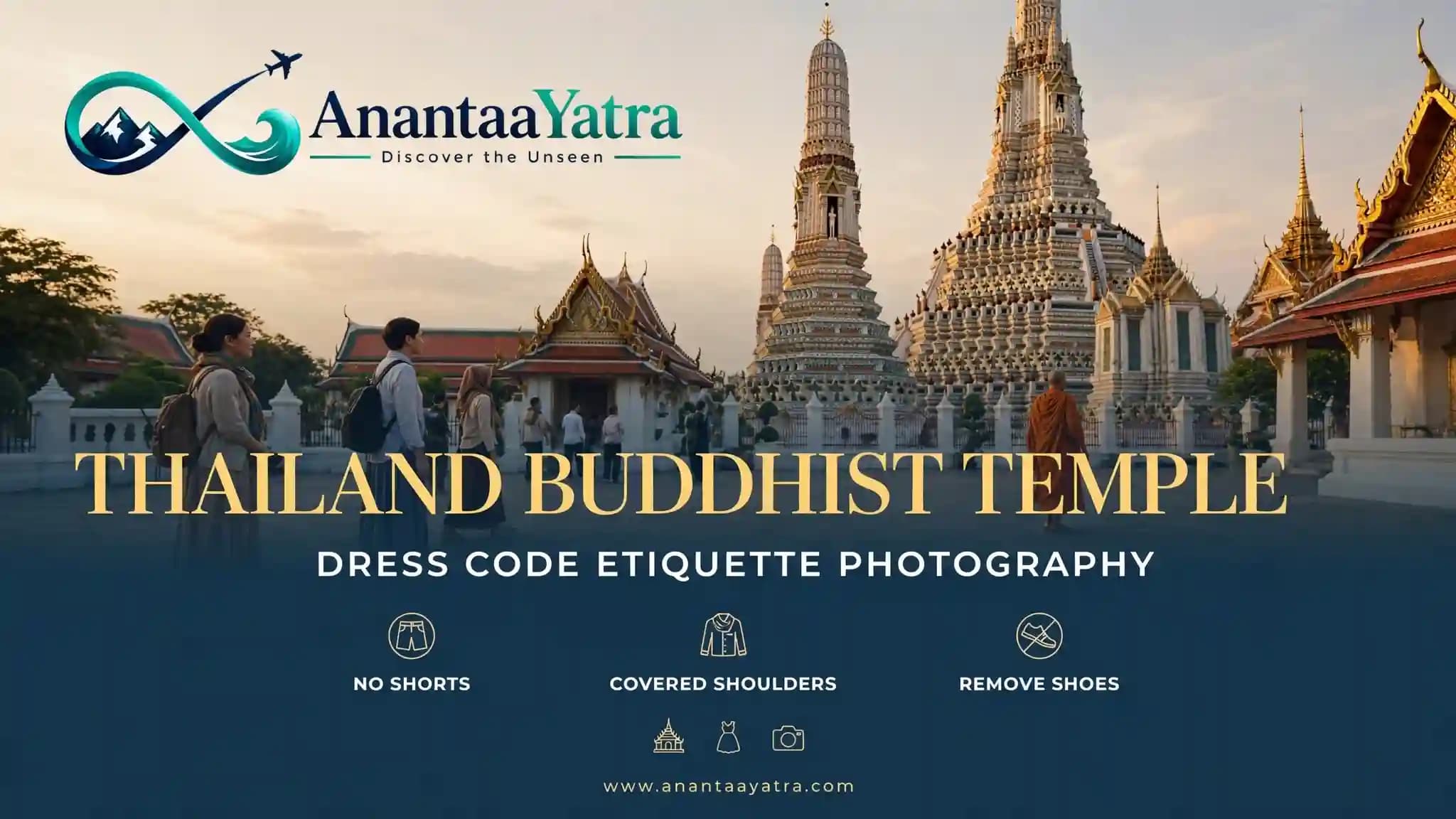
“Visiting Buddhist temples in Thailand? Learn dress codes, shoe-removal rules, monk etiquette, photography restrictions, temple entry fees and respectful travel tips.”
Thailand · Culture & Travel Etiquette
Visiting Buddhist Temples in Thailand: Dress Codes, Etiquette & Photography Rules
Thailand's Buddhist temples are places of worship, community life and extraordinary architecture. Visitors are welcome at many of them, but a little preparation makes the experience more comfortable for everyone.
Knowing what to wear, when to remove your shoes and how to take photographs respectfully can save you from being turned away at the entrance—or accidentally disturbing someone who is praying.
This guide explains the general etiquette, highlights stricter rules at major temples and compares admission costs for two of Bangkok's best-known religious landmarks.
Temple entry fees in Bangkok: quick comparison
Temple etiquette is not something you pay for, but entry fees and visitor rules can affect your itinerary. The prices below are the currently published rates found on the official temple websites. Check them again before your visit.
| Temple or complex | Published foreign visitor fee | Dress-code note | Useful planning tip |
|---|---|---|---|
| The Grand Palace and Wat Phra Kaew | ฿500 | Strict rules: no sleeveless shirts, short shorts, see-through tops, torn or tight trousers and several other items. | Check the official entry and ticketing information before travelling. |
| Wat Pho | ฿300 | Respectful clothing required; check the temple's visitor guidance for current restrictions. | It is close to the Grand Palace area and can fit into the same sightseeing day. |
| Other temples and local wats | Varies; some have no general visitor fee | Modest dress and respectful behaviour remain important even where admission is free. | Follow the specific signs at the entrance and inside each building. |
Prices are in Thai baht (THB). Admission, access areas, opening hours and visitor policies can change. The Grand Palace fee includes Wat Phra Kaew and the Queen Sirikit Museum of Textiles according to its official visitor information. Always verify current details with the venue.
The easiest dress-code rule to remember
Wear a top that covers your shoulders, choose trousers or a skirt that covers your knees, and carry a light cover-up. At the Grand Palace, do not assume a scarf will make every outfit acceptable: follow the full official dress code.
1. What should you wear to a Buddhist temple in Thailand?
Aim for clean, modest clothing that covers your shoulders and knees. You do not need to buy traditional Thai clothing; a simple outfit that is comfortable in the heat and suitable for a place of worship is enough.
Clothing that is usually a safe choice
- Lightweight trousers or long, loose-fitting pants.
- A skirt or dress that covers the knees, with a modest neckline.
- A T-shirt or blouse with sleeves that cover the shoulders.
- A light scarf or shawl as a backup layer where appropriate.
- Comfortable shoes that are easy to remove at temple entrances.
Clothing to avoid
- Tank tops, sleeveless tops and crop tops.
- Short shorts and mini skirts.
- Transparent, very revealing or excessively tight clothing.
- Torn trousers or outfits that expose the thighs or midriff.
- Clothing with offensive graphics or slogans.
These are general guidelines, not a guarantee that every outfit will be accepted. Some temple complexes enforce more specific rules. The Grand Palace, for example, lists tight trousers, short tops, see-through tops, torn pants, sleeveless shirts and several other garments among its prohibited clothing.
Check the Grand Palace's official visitor information if it is on your itinerary.
Travelling in hot weather?
Choose breathable fabrics rather than heavy layers. A loose cotton or linen shirt with lightweight trousers is often more comfortable than tight clothing. Pack a separate temple outfit if your day also includes beaches, markets or outdoor activities.
2. Shoes, hats and entering temple buildings
You generally remove your shoes before entering a temple hall or other sacred building where required. Look for shoe racks, rows of footwear by the steps or a sign at the entrance. If visitors are removing their shoes and the building is clearly a worship space, pause and check before entering.
You can often keep your shoes on while walking through open courtyards, but practices vary by building and temple. Follow the signs and staff instructions rather than assuming the same rule applies everywhere.
Make it easy on yourself
- Wear slip-on shoes or sandals that you can remove easily.
- Keep footwear together in the designated area rather than blocking a doorway.
- Carry a small bag if the temple asks visitors to keep their shoes with them.
- Remove your hat before entering a sacred building if local practice or signs require it.
- Keep your phone on silent and avoid taking calls inside prayer halls.
Some traditional doorways have a raised threshold. Step over it rather than deliberately standing on it. Most importantly, watch what the temple asks visitors to do and move calmly through the entrance.
3. Thai temple etiquette: how to behave respectfully
A temple is not simply an architectural attraction. People may be praying, making offerings, attending a ceremony or taking a quiet moment during an ordinary day. Visitors can appreciate the site without interrupting those activities.
Respectful behaviour inside a temple
- Keep your voice low. Avoid shouting, playing music or talking loudly inside halls.
- Put your phone on silent. Do not take calls while people are praying or meditating.
- Keep your feet away from Buddha images. If sitting on the floor, fold your legs to the side or sit cross-legged.
- Do not climb on statues or historic structures. This can be disrespectful and may damage the site.
- Do not touch sacred objects without permission. Admire murals, statues and offerings without handling them.
- Keep the grounds clean. Take rubbish with you or use the bins provided.
- Avoid public displays of affection. Keep your behaviour understated in sacred spaces.
- Follow restricted-area signs. Some rooms, platforms and buildings are reserved for religious use.
How should you sit in front of a Buddha image?
If you sit on the floor, avoid stretching your legs straight out with your feet pointing toward a Buddha image or a monk. Tuck your feet behind you or to one side. If kneeling is uncomfortable, it is usually better to stand quietly at the back than to force yourself into a painful position.
Should you bow or make a wai?
You are not required to copy every religious gesture. A calm manner and a respectful attitude are enough. If you choose to offer a wai—a gesture made by bringing the palms together—do so naturally rather than treating it as a photo prop.
4. Respectful behaviour around Buddhist monks
Monks have religious practices and personal boundaries that visitors should respect. Do not interrupt someone who is meditating or speaking with another person, and never assume that a monk is available for a photograph simply because you see one in a public area.
Important points for visitors
- Speak politely and keep a respectful distance.
- Ask before taking a close-up photograph of a monk.
- Women should avoid physical contact with monks and should not hand items directly to them.
- If you wish to make an offering, ask temple staff how to do so appropriately.
- Do not sit on platforms or chairs clearly reserved for monks.
- Never interrupt a religious ceremony just to get a photograph.
Customs can vary by monastery and by the situation. If you are unsure how to offer something or where to sit, ask a member of staff or observe what visitors are being instructed to do.
5. Photography rules at Thai Buddhist temples
Photography is not governed by one universal rule across Thailand. Some outdoor areas welcome photography, while certain buildings, sacred images or ceremonial spaces may have restrictions. The most reliable rule is to check signs at the entrance and follow the instructions of temple staff.
Photography etiquette checklist
- Look for signs before taking out your camera. A photography ban may apply to a specific room or object rather than the entire site.
- Ask before photographing people. Be especially careful around people praying, meditating or making offerings.
- Avoid disrespectful poses. Do not climb on, lean against or imitate poses with Buddha images.
- Do not block worshippers. Move aside for people entering, leaving or praying.
- Keep flash off when prohibited. Flash can disturb worshippers and may be restricted near artworks.
- Do not use a drone without explicit authorisation. Restrictions may apply around major religious or royal sites.
- Respect staff instructions immediately. If someone asks you to stop photographing, put the camera away.
Can you take selfies with Buddha statues?
Avoid posing in a way that treats a Buddha image as a novelty or prop. In particular, do not climb onto a statue, mimic a sacred pose for a joke or arrange a photograph that appears disrespectful. Even where photography is allowed, the manner of the photograph matters.
Can you photograph ceremonies?
Do not assume that a public ceremony means unrestricted photography. People may be engaged in prayer, chanting or making merit. Ask permission before taking close-up pictures, and follow any restrictions announced by the temple.
Thailand's government publishes a Thai Temple Travel Guide that specifically advises visitors to respect photography restrictions, avoid photographing people engaged in religious activities without permission and behave respectfully around Buddha images.
6. Rules at the Grand Palace, Wat Pho and Wat Arun
The same basic etiquette applies across Thailand, but each temple has its own visitor policies. These three Bangkok landmarks are popular enough that checking the rules before leaving your hotel is worthwhile.
The Grand Palace and Wat Phra Kaew
The Grand Palace has a detailed dress code and is stricter than many smaller local temples. Its official guidance lists sleeveless shirts, vests, short tops, see-through tops, short shorts, torn pants, tight pants, bike pants, mini skirts and other items as unsuitable for entry.
The official site currently lists a ฿500 ticket for foreign visitors, including access to Wat Phra Kaew and the Queen Sirikit Museum of Textiles. It also publishes visitor information and specific regulations covering visits, filming and photography.
Before visiting, check the official Grand Palace practical information for the latest clothing, ticket and photography rules.
Wat Pho
Wat Pho is known for its Reclining Buddha and traditional Thai massage school. The temple asks visitors to dress respectfully, remove shoes before entering religious buildings and behave quietly within the grounds. Its published foreign visitor admission fee is currently ฿300.
Read the official Wat Pho visitor plan and etiquette guidance before your visit. Do not assume that a photography rule at one building automatically applies to every area of the complex.
Wat Arun
Wat Arun, on the west bank of the Chao Phraya River, is one of Bangkok's best-known temple landmarks. It is especially popular for its riverside setting and detailed architecture, so it can be tempting to focus on getting the perfect photograph.
Follow the site's current photography signs and any staff instructions. Do not climb restricted structures or use a pose that could damage the architecture or interfere with worshippers. Policies may change, so check local notices on arrival rather than relying on older social-media posts.
Remember: a photography rule can apply to one area of a temple but not another. The rule on the sign in front of you takes priority over a general guide.
7. How to plan a respectful temple visit in Bangkok
If you want to visit several temples in one day, group nearby places together and leave time to read the signs, take breaks and observe the surroundings. A temple visit should not feel like a race to collect photographs.
A simple old-city temple day
- Start with the Grand Palace and Wat Phra Kaew. Dress according to the official rules and check ticket availability before travelling.
- Continue to Wat Pho. Allow time to explore the complex respectfully and take a break between visits.
- Consider Wat Arun separately. Cross the river when convenient and check current photography restrictions on arrival.
- Plan your return journey. Use public transport or the river boats where practical, and allow extra time during busy periods.
For transport planning, read our Bangkok BTS, MRT and river-boat guide. If you want to explore more of the city after temple visits, our guide to where to stay in Bangkok: Sukhumvit, Silom or the riverside can help you choose a convenient base.
A longer stay gives you more flexibility. Use our five-day Thailand trip cost guide to plan spending, or our luxury Thailand vacation guide if you are building a more premium itinerary.
What else can you add to a Thailand trip?
- Chiang Mai travel guide for temples and northern Thailand culture.
- Phuket vs Krabi for choosing a beach destination.
- Koh Samui beachfront resorts for a relaxing island stay.
- Pattaya beyond Walking Street for culture and coastal sightseeing.
- Bangkok to Pattaya transport guide for planning a short side trip.
- Phuket to Koh Phi Phi ferry guide for island transfers.
If your trip includes driving, review our Thailand scooter rental, licence and insurance guide before renting a vehicle. For food planning, see our Bangkok Michelin street-food guide. If you're looking for wildlife experiences, our ethical elephant sanctuary guide explains how to assess animal-welfare claims.
Choosing accommodation?
Browse Anantaayatra hotel options and choose a base that makes your temple itinerary easy to manage.
Frequently asked questions
What should I wear to a Buddhist temple in Thailand?
Choose modest clothing that covers your shoulders and knees, such as a sleeved top with long trousers or a long skirt. Avoid transparent, revealing or torn clothing. Some major temples enforce stricter rules, so check the official visitor guidance.
Do I need to remove my shoes at Thai temples?
Remove your shoes before entering temple halls and other buildings where signs or local practice require it. Follow the shoe racks and instructions at each entrance.
Can tourists take photographs inside Thai temples?
Photography is allowed in some areas and prohibited in others. Follow signs and staff instructions, never photograph people praying without permission, and avoid disrespectful poses with Buddha images.
Can women touch Buddhist monks in Thailand?
Women should avoid physical contact with monks and should not hand items directly to them. If offering something, follow the monk's instructions or ask temple staff how to do so respectfully.
How much does the Grand Palace cost for foreign visitors?
The official Grand Palace website currently lists admission for foreign visitors at ฿500, including Wat Phra Kaew and the Queen Sirikit Museum of Textiles. Check the official site before visiting for current ticket and entry information.
How much is admission to Wat Pho?
Wat Pho currently lists a foreign visitor admission price of ฿300. Confirm current opening hours, admission and dress requirements on the temple's official website.
Can I wear shorts if I carry a scarf?
A scarf may help cover your shoulders, but it does not guarantee that shorts will be accepted. At strict venues such as the Grand Palace, follow the complete dress code and wear suitable trousers or a long skirt.
Is it disrespectful to take a selfie with a Buddha image?
Avoid poses that treat Buddha images as props or appear disrespectful. Never climb on statues, touch sacred objects without permission or interrupt worshippers for a photograph.
Final tips for visiting temples in Thailand
The most useful preparation is simple: dress modestly, remove your shoes where required, keep your voice low, respect monks and worshippers, and check the photography rules before taking pictures.
Major attractions such as the Grand Palace may enforce stricter clothing rules than smaller local temples. Plan ahead, follow the signs and avoid assuming that a rule at one site applies everywhere.
A little awareness lets you appreciate Thailand's architecture and religious traditions without disrupting the people who come to practise their faith.
Editorial note: Entry fees, opening hours, dress requirements and photography policies can change. Confirm current information through official temple sources before your visit.