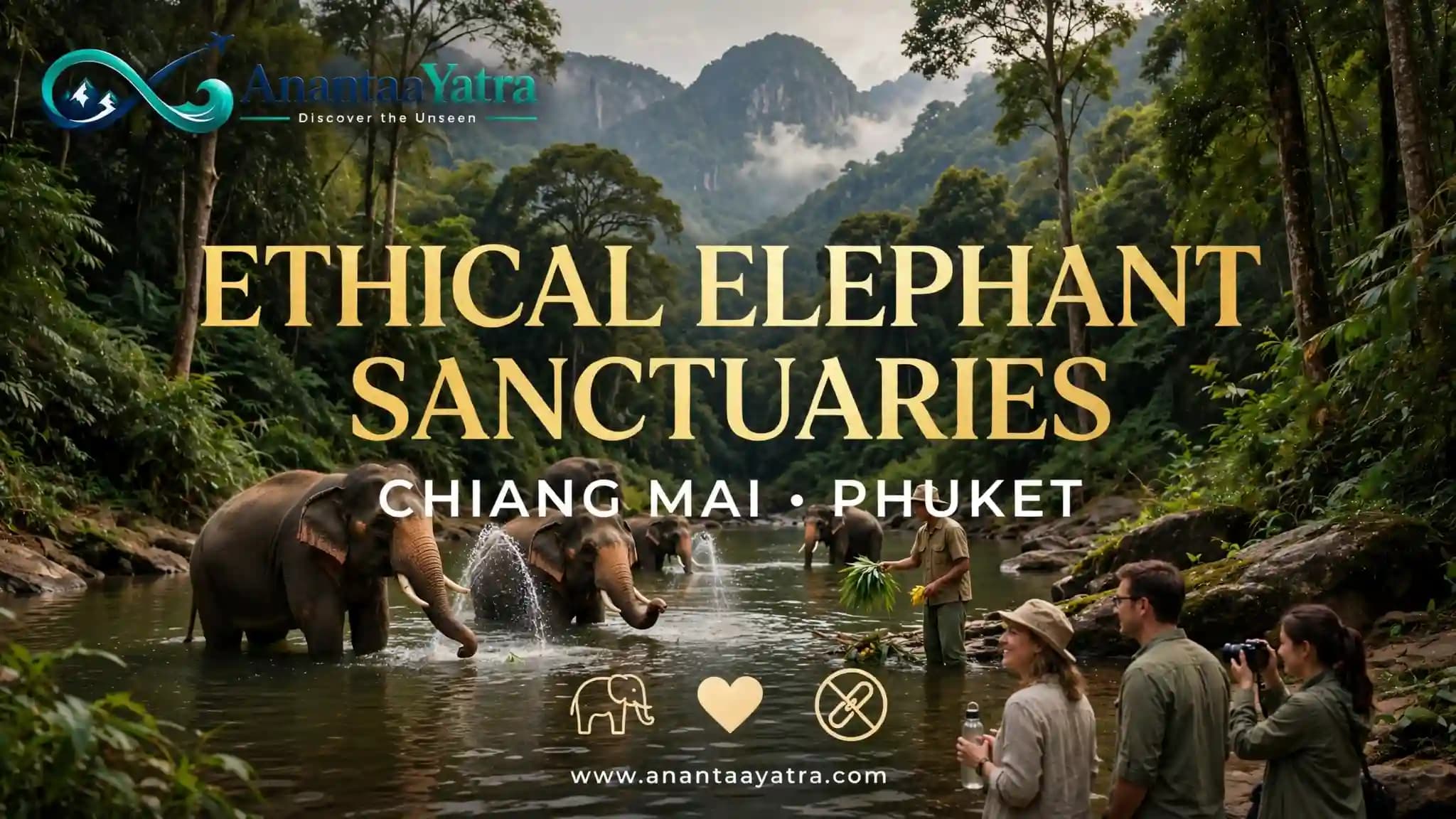
“Find ethical elephant sanctuaries in Chiang Mai and Phuket. Compare prices, spot animal-welfare red flags, and choose responsible, observation-led experiences in Thailand.”
Thailand · Responsible Wildlife Travel
Ethical Elephant Sanctuaries in Chiang Mai & Phuket: How to Spot Responsible Sanctuaries
Seeing an elephant in Thailand can be an unforgettable experience. But the way visitors meet these animals matters. A venue may use words such as “rescue”, “retirement home” or “sanctuary” and still offer activities that put human entertainment ahead of an elephant’s welfare.
The better approach is to look beyond the name. Does the venue allow elephants to forage, socialise and move around with choice? Can visitors observe without touching or directing the animals? Is the organisation transparent about its care practices?
This guide compares options to investigate in Chiang Mai and Phuket, explains the warning signs, and helps you decide what to ask before paying for a visit.
Ethical elephant sanctuaries: quick comparison
These two venues are useful starting points for research because World Animal Protection includes them in its elephant-friendly guidance. The prices below are the published rates found during research; always check the official booking page for the exact programme, transfer arrangements and latest welfare policy.
| Venue | Location | Indicative adult price | Experience focus | Best suited to |
|---|---|---|---|---|
| ChangChill | Chiang Mai province | ฿1,900 for the listed half-day programme | Observation, natural behaviour and education | Travellers staying in Chiang Mai who prefer a guided, observation-led visit |
| Phuket Elephant Sanctuary | Phuket | From ฿3,000 for the listed half-day programme | Observation, conservation education and veterinary-care learning | Visitors who want to learn about rescued elephants during a Phuket stay |
Prices are in Thai baht (THB) and are subject to change. The programmes have different durations and inclusions, so the lowest price is not necessarily the best value. Transfers, meals, child rates and cancellation terms may vary. Confirm all details directly before booking.
Our responsible-travel rule
Prioritise venues where you observe elephants from a respectful distance and the animals choose what to do. Avoid riding, performances, forced bathing, painting, posing with elephants or any activity that requires animals to tolerate constant direct contact.
1. What makes an elephant sanctuary responsible?
A responsible elephant venue puts the animals’ needs ahead of visitor entertainment. That means providing appropriate care, space, social opportunities, veterinary attention and the freedom to display natural behaviours as far as the animals’ circumstances allow.
Many elephants in tourism have histories of working in logging, riding camps or other commercial settings. Some have physical injuries or long-term health needs. A genuine welfare-focused operation should be able to explain each elephant’s background, its current care plan and the limits of what visitors can do.
Look for these positive signs
- Observation comes first. Visitors watch from a respectful distance rather than touching or directing elephants.
- Elephants can choose. They can move away, forage, rest or socialise without being made to perform for a group.
- The habitat supports natural behaviour. There is room to move, access to appropriate food and opportunities for social interaction.
- Welfare information is transparent. Staff can explain veterinary care, rescue histories, social groups and daily routines.
- Tourism does not depend on tricks. The programme focuses on education and conservation rather than shows, rides or close-contact photographs.
- Visitor numbers are managed. Groups are not allowed to crowd animals or block their movement.
One useful starting point is the independent World Animal Protection elephant-friendly tourist guide. Its guidance stresses natural behaviour, space and reduced human contact. Use it as one part of your assessment, not as a substitute for checking a venue’s latest policies.
Why the word “sanctuary” is not enough
“Sanctuary” is widely used in tourism marketing. The name alone does not establish the quality of care, the amount of space available or whether elephants are asked to participate in activities for visitors.
Look for clear, specific answers. If a venue says its programme is ethical but will not explain how it manages contact, restraint, veterinary care or visitor groups, treat that as a reason to investigate further.
2. Chiang Mai: ChangChill
Chiang Mai is one of Thailand’s best-known bases for elephant tourism. That also means visitors have many programmes to compare, and the word “sanctuary” can appear across experiences with very different policies.
ChangChill is a venue to investigate if you want a guided experience built around observing elephants. Its published half-day programme lists an adult price of ฿1,900 and describes visitors observing elephants grazing and socialising from a safe distance, alongside educational explanations from guides.
The venue’s programme includes travel time from Chiang Mai city, so do not treat the advertised visit as a short stop close to the Old City. Confirm the pick-up time, drop-off time and what the package includes before making other plans.
What to expect
- A guided introduction to the elephants and the venue’s approach to care.
- Opportunities to observe natural behaviours rather than watch a performance.
- Explanations about elephant behaviour, daily care and conservation.
- A countryside journey that takes a substantial part of the day.
Read the current programme details directly on the official ChangChill half-day visit page. Check its latest welfare policies before booking, particularly if a third-party listing describes activities that do not appear on the venue’s own website.
Planning tip
Keep your Chiang Mai itinerary flexible on the day of the visit. The journey can take around an hour and a half or longer depending on the route and conditions. If you want more ideas for the city, use our Chiang Mai travel guide to plan temples, markets and mountain excursions around your sanctuary visit.
3. Phuket: Phuket Elephant Sanctuary
Phuket is often associated with beaches and island excursions, but it also has elephant venues that focus on rescue, care and observation. If you are already staying on the island, choosing a responsible visit can be easier than travelling to another province just for an elephant experience.
Phuket Elephant Sanctuary describes a programme in which visitors observe elephants as they forage, socialise and bathe freely. Its published half-day programme starts from ฿3,000 for adults and lasts approximately three and a half hours. The programme also describes education about elephant care and a visit to its elephant hospital.
World Animal Protection’s current elephant-friendly guidance lists Phuket Elephant Sanctuary among its elephant-friendly venues and notes that the venue announced a phase-out of hand-feeding by April 2026. As policies can evolve, check the latest visitor-contact rules before booking.
What to expect
- Guided observation of elephants from a respectful distance.
- Information about rescued elephants and their individual histories.
- An educational element focused on elephant welfare and care.
- A scheduled half-day visit, with transfer options depending on the booking.
For current programme descriptions, inclusions and prices, visit the official Phuket Elephant Sanctuary half-day programme. Check whether transport is included in the rate you select and confirm the meeting or hotel pick-up details.
Phuket planning tip
Avoid scheduling your sanctuary visit too close to a ferry departure or airport transfer. If you are combining Phuket with Phi Phi, leave a buffer for traffic and weather. Our guides to Phuket vs Krabi and Phuket to Koh Phi Phi transfers can help with the wider itinerary.
4. Red flags: how to spot an irresponsible elephant attraction
A polished website, emotional rescue story or attractive social-media feed is not enough to establish good welfare. Look at the actual activities offered and the conditions the elephants live in.
Activities that should make you pause
- Elephant riding. Do not book a riding experience, even if the operator describes the saddle as comfortable or the elephants as well trained.
- Shows and tricks. Dancing, painting, football or similar performances prioritise entertainment over natural behaviour.
- Tourist bathing and scrubbing. An elephant entering water by choice is different from visitors being instructed to wash, scrub or pose with it.
- Constant touching and close-up selfies. A programme that requires elephants to stand still while groups touch them does not give the animals meaningful control over the interaction.
- Baby elephants promoted as photo opportunities. Ask about the young animal’s history, family group and why visitors are allowed to approach it.
- Unclear restraint practices. Ask how the venue manages safety, what restraint equipment is used and when it is used.
- Vague conservation claims. “We rescue elephants” should be supported by transparent information about the animals, their care and how tourism revenue is used.
Is feeding an elephant always ethical?
Feeding may look harmless, but it is still a direct interaction that can be designed around visitor access rather than the elephant’s needs. Consider whether feeding happens behind a barrier, whether the elephant can move away, how food portions are controlled and whether the programme is moving towards observation without contact.
World Animal Protection distinguishes between venues following its elephant-friendly guidelines and venues that still allow some forms of interaction, such as hand-feeding over a barrier. That distinction is a reminder to read the category and current conditions carefully rather than relying on a broad “ethical” label.
Simple rule: if the main selling point is touching, riding, bathing, posing or performing with an elephant, choose a different experience. Observation-led visits give elephants more control over how they spend their time.
5. Questions to ask before booking
A responsible operator should be able to explain its practices clearly. Send these questions by email or message before paying a deposit.
- Is any riding or performance offered? Look for an unambiguous answer.
- Can visitors touch or bathe the elephants? Ask about every part of the programme, not only the headline activity.
- Can elephants choose to move away? Ask how visitor groups are kept at a respectful distance.
- How much time do elephants spend foraging and socialising? Ask what their day looks like when visitors are not present.
- How are new elephants rescued or acquired? Ask about the venue’s policies on breeding, transfers and commercial sourcing.
- What veterinary care is available? Ask how routine care and urgent treatment are handled.
- What does the ticket price include? Confirm transfers, food, guide fees, taxes, child rates and cancellation terms.
- Does an independent welfare organisation assess the venue? Ask for the name, date and scope of any assessment.
No single answer proves that a venue is responsible. Look for consistent policies, specific evidence and a willingness to explain difficult questions without relying solely on emotional marketing.
6. How to plan a responsible elephant sanctuary visit
Choose your destination first
If Chiang Mai is already part of your northern Thailand itinerary, investigate ChangChill and compare the total travel time with the rest of your plans. If your trip centres on beaches and island-hopping, Phuket Elephant Sanctuary may be more practical.
Our seven-day Thailand itinerary can help you plan a trip that includes Bangkok, Phuket and Phi Phi. If you have more time, compare it with our 10-day island-hopping itinerary.
Budget beyond the ticket price
A sanctuary visit may also involve transport, meals, travel insurance and the cost of getting to the meeting point. Compare the full package rather than choosing solely by the advertised entrance price.
For a realistic overall trip budget, read our five-day Thailand trip cost guide. You can also browse Anantaayatra hotel options to plan accommodation close to the transport routes that suit your itinerary.
Prepare for a day outdoors
- Wear comfortable, closed-toe shoes suitable for uneven paths.
- Bring sun protection and insect repellent if permitted by the venue.
- Carry drinking water and follow the operator’s rules on food and personal items around animals.
- Use a camera zoom rather than approaching an elephant for a photograph.
- Follow staff instructions and never attempt to touch or feed an elephant outside the permitted programme.
- Do not shout, surround an animal or block its path to get a better photo.
If you are travelling internationally, check your entry requirements and mobile connectivity before departure. Anantaayatra also has practical guides to Thailand Visa on Arrival vs e-Visa, Thailand entry requirements, Thailand SIM cards and eSIMs and drinking water safety in Thailand.
For general awareness while moving around tourist areas, see our guide to common Thailand tourist scams. It is separate from elephant welfare, but useful for planning a safer trip.
Frequently asked questions
How can I tell if an elephant sanctuary is ethical?
Look for observation-led visits, meaningful space for elephants to forage and socialise, no riding or performances, no forced bathing or touching, transparent welfare policies and independent welfare assessments.
Are elephant bathing experiences ethical?
Tourist bathing can require elephants to tolerate close human contact and follow human direction. A more cautious choice is a venue where elephants bathe on their own terms and visitors observe from a respectful distance.
How much does an ethical elephant sanctuary cost in Thailand?
Published prices vary by venue and programme. As a reference, ChangChill lists a half-day programme at ฿1,900 per person, while Phuket Elephant Sanctuary lists its half-day programme from ฿3,000. Confirm the current price and transfer inclusions before booking.
Which elephant sanctuaries can I consider in Chiang Mai?
ChangChill is one option to investigate because it offers observation-led visits and is listed by World Animal Protection among elephant-friendly venues. Check the latest independent welfare guidance and the venue’s current policies before booking.
Which elephant sanctuary can I consider in Phuket?
Phuket Elephant Sanctuary is an observation-led option to investigate. Its official programme describes observing elephants from a respectful distance, learning about veterinary care and watching natural behaviours. Confirm its latest policies and prices before visiting.
Does the word sanctuary guarantee good animal welfare?
No. The word sanctuary is not, by itself, proof of high welfare. Review independent assessments, contact policies, living conditions, veterinary care and how the venue explains its elephant management practices.
Can children visit an elephant sanctuary?
Some observation-led programmes welcome children, but age rules vary. Check the venue’s minimum age, walking requirements, transfer duration and safety guidance before booking.
Should I book directly or through a tour operator?
Booking directly makes it easier to confirm the venue’s own policies, programme inclusions and cancellation rules. If you use an agent, ask for the exact venue and activity schedule before paying.
The most responsible way to see elephants in Thailand
A good elephant encounter does not need a ride, a bath or a photograph with an animal standing beside you. Watching an elephant forage, socialise, rest or choose its own path can be meaningful without turning its behaviour into a performance.
ChangChill in Chiang Mai and Phuket Elephant Sanctuary in Phuket are useful places to begin your research, with published observation-led programmes and listings in World Animal Protection’s elephant-friendly guidance. Still, confirm the latest welfare policy, activity list and price before making a booking.
The best choice is the venue that can show how it protects elephant welfare in practice—not simply the one with the most appealing photos or the word “ethical” in its name.
Planning the rest of your Thailand trip?
Explore more guides on Anantaayatra or compare accommodation options through our hotel page.
Editorial note: Venue policies, welfare assessments, programme details and prices can change. This guide uses publicly available information as a starting point and does not constitute a formal animal-welfare audit or guarantee of any operator’s practices. Verify current information directly before booking.