Thailand Entry Requirements : Return Tickets, Cash & Immigration Rules
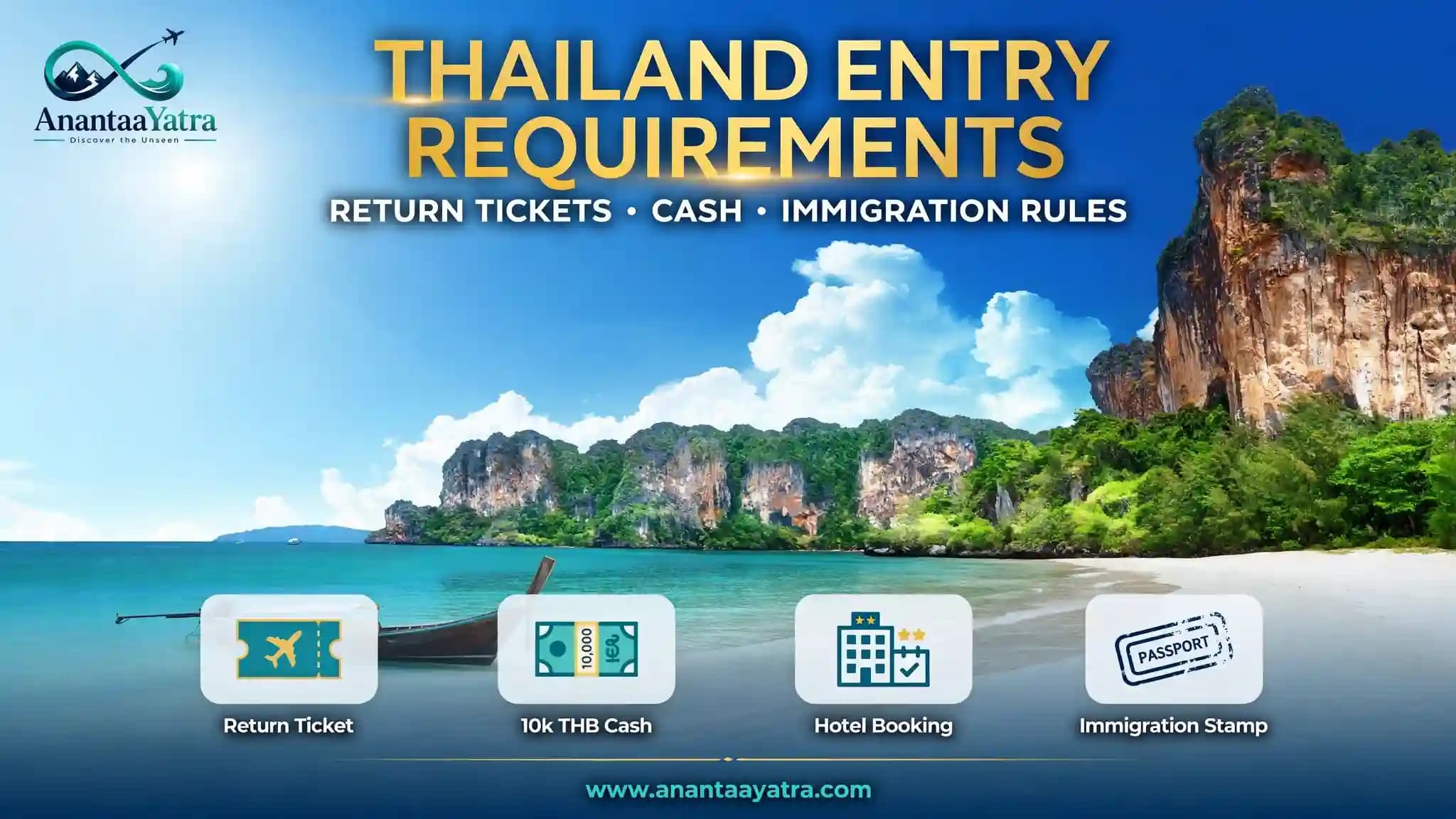
“Thailand entry requirements explained: return-ticket proof, immigration checks, proof of funds, cash declaration limits and the Digital Arrival Card for Indian travellers.”
Thailand Entry Requirements: Immigration Rules, Return Ticket Proof & Cash Declarations
A smooth arrival in Thailand starts before you board your flight. Immigration officers may ask about your travel purpose, where you will stay, how you will pay for the trip and when you plan to leave. If you are carrying a large amount of cash, separate customs rules may also apply. This guide explains what to prepare, with a focus on Indian travellers and practical advice for other visitors.
Entry conditions can change and differ by nationality, passport type and visa category. Confirm the latest rules with Thai immigration authorities or the Thai embassy responsible for your application.
Thailand entry checklist at a glance
- Passport: Carry a valid passport that meets the current validity requirements for your entry category.
- Visa or exemption: Check whether your nationality qualifies for visa exemption or requires a visa.
- Return or onward ticket: Keep confirmed travel evidence showing that you plan to leave within your permitted stay.
- Proof of funds: Be prepared to show sufficient funds or equivalent evidence if immigration requests it.
- Accommodation: Keep your first hotel or accommodation address available.
- TDAC: Complete the Thailand Digital Arrival Card through the official portal within the permitted pre-arrival window.
- Cash declaration: Check the current declaration rules if carrying large amounts of foreign currency or Thai baht.
Thailand entry requirements: comparison table
These checks are related, but they are not interchangeable. A traveller may qualify for visa exemption and still need to answer questions at immigration or comply with a customs declaration requirement.
| Requirement | What to prepare | Who may ask for it? | Practical tip |
|---|---|---|---|
| Passport and entry eligibility | Valid passport and the correct visa, exemption eligibility or other permission. | Airline staff and immigration officers. | Check your nationality's rules before buying non-refundable tickets. |
| Return or onward ticket | Confirmed flight, bus, train or other appropriate evidence of departure, depending on the route and rules. | Airline staff and/or immigration officers. | Make sure the departure date falls within your permitted stay. |
| Proof of funds | Cash, accepted equivalent funds or supporting evidence that you can finance your stay. | Immigration officers. | Keep evidence accessible rather than buried in checked luggage. |
| Accommodation details | Hotel booking, host address or first-night stay details. | Immigration officers, if requested. | Save the full address and contact details offline. |
| Thailand Digital Arrival Card | Electronic arrival information submitted through the official TDAC portal. | Airline or immigration staff may ask to see the confirmation. | Submit it in the official window before arrival; the government service is free. |
| Cash declaration | Customs declaration when the relevant currency threshold is exceeded. | Thai Customs. | Check the current threshold for the currencies and instruments you carry. |
Do Indian travellers need a visa for Thailand in 2026?
As of 15 September 2026, ordinary Indian passport holders can use Thailand's 30-day visa-exemption scheme for qualifying tourism and short-term business engagements, subject to the current entry conditions. This replaced the older situation described in many online articles that still refer to Indian travellers using Visa on Arrival for ordinary short holidays.
Visa exemption does not mean that every visit is permitted without a visa. A longer stay, employment, study or another purpose may require a different visa category. Passport type and other individual circumstances can also affect eligibility.
Check the current notice from the Royal Thai Embassy in New Delhi before travelling.
For a more detailed explanation of visa routes, see our related guide: Thailand Visa on Arrival vs. E-Visa: Fees, Documents & Fast-Track Options.
Passport validity and immigration checks
Your passport is the central travel document for entry. Check that it is in good condition and meets the validity rules that apply to your nationality and entry category. Some visa and airline guidance refers to six months of remaining validity, but the exact rule should be confirmed for your case rather than assumed to be universal.
Immigration officers may check your passport, visa or visa-exemption eligibility, arrival information and the purpose of your trip. They may also ask about your itinerary, accommodation, funds and plans to leave Thailand.
- Check the passport expiry date before booking.
- Ensure that your name and passport number match your flight booking.
- Keep your visa or entry-permission evidence available where applicable.
- Answer immigration questions truthfully and consistently.
- Do not assume that a visa or exemption automatically guarantees admission.
Do you need a return ticket to enter Thailand?
Travellers may be asked to show evidence that they intend to leave Thailand within the period they are allowed to stay. A confirmed return flight is the clearest example, although the appropriate evidence may depend on your route and circumstances.
What counts as useful onward-travel evidence?
- A confirmed return flight to your home country.
- A confirmed onward flight to another destination you are entitled to enter.
- Other documented onward travel, where it is accepted for your particular route and entry category.
Your ticket should make sense alongside your declared itinerary. For example, if you are entering under a short-stay exemption, a departure date beyond the permitted stay could lead to questions.
What if you plan to leave Thailand by land?
Do not assume that an unconfirmed plan to cross a border is sufficient. Check whether your proposed route and travel evidence meet the requirements for your entry category. If you plan to visit another country, confirm that you can enter that country too.
Should you buy a fully refundable ticket?
A refundable or changeable ticket can reduce financial risk if your plans change, but it is not a special immigration requirement in itself. Read the fare conditions carefully and make sure your ticket is actually confirmed.
How much money must you show at Thai immigration?
Thai authorities may ask visitors to show that they have enough money for their stay. The Tourism Authority of Thailand published the following reference amounts in its July 2026 entry reminder.
| Entry category | Per person | Per family |
|---|---|---|
| Transit visa and certain visa-exempt cases | THB 10,000 | THB 20,000 |
| Visa on Arrival | THB 10,000 | THB 20,000 |
| Tourist visa | THB 20,000 | THB 40,000 |
| Non-immigrant visa | THB 20,000 | THB 40,000 |
These are published reference amounts, not a promise that every traveller will be assessed identically. The official reminder says requirements can vary by entry category and advises travellers entering under visa exemption to check the latest guidance for their nationality and departure point. It also notes that the requirement does not apply to children under 12.
Read the Tourism Authority of Thailand's proof-of-funds reminder and check current advice with the relevant Thai embassy.
Does proof of funds have to be cash?
Published guidance refers to cash, equivalent funds or documents evidencing payment of an equivalent amount, depending on the category. However, you should not assume that every officer will accept every form of financial evidence in every situation. Carry a practical amount of accessible cash and keep any supporting evidence available.
Can a credit card replace cash?
A credit card may be useful supporting evidence, but it should not be treated as a guaranteed substitute for the funds an officer asks you to demonstrate. If you rely on bank or card evidence, make sure you can access the relevant account or documents during the journey.
Thailand cash declaration rules: what is the limit?
Proof of funds for immigration and a customs declaration for currency are two different things. The first concerns whether you can support your stay. The second concerns reporting currency or monetary instruments when you cross a border.
Foreign-currency banknotes: check the current threshold
The Bank of Thailand's current exchange-control guidance says that foreign-currency banknotes exceeding the equivalent of US$15,000 must be declared to Customs when entering or leaving Thailand.
Another Thai government information page still lists a US$20,000 threshold. Because official pages differ, travellers carrying a large amount should confirm the applicable rule directly with Thai Customs before departure.
Official references: Bank of Thailand — exchange-control regulations and Thailand government — bringing currency into or out of the country.
What about Thai baht?
Thai baht banknotes have separate rules, particularly when taking money out of Thailand. The Bank of Thailand says a customs declaration is required when bringing into or taking out of the country Thai baht banknotes exceeding THB 450,000. Separate export limits may apply depending on the destination country.
If you are carrying a large amount of Thai baht or a mix of currencies, check the current Customs and Bank of Thailand guidance for your exact circumstances.
What should you do if you need to declare cash?
- Calculate the total amount of physical currency you are carrying.
- Check the latest declaration threshold for the currency and route.
- Use the relevant customs declaration procedure when required.
- Keep copies of the declaration and any supporting documents.
- Answer questions from customs officials accurately.
Do not split currency between bags or companions to avoid a legal declaration requirement. If you are unsure whether your funds are declarable, ask Customs before passing through the checkpoint.
Thailand Digital Arrival Card (TDAC)
The Thailand Digital Arrival Card is an electronic arrival-information form. It is not a visa and does not replace visa-exemption eligibility or a visa where one is required.
- Use the official TDAC website.
- Submit the form within the permitted three-day window before arrival, including the arrival date.
- Enter your passport, travel and accommodation information accurately.
- Save the confirmation so you can retrieve it during your journey.
- Do not pay a third-party website simply to access the official free form.
Official portal: Thailand Digital Arrival Card.
Follow the live instructions on the official portal, including any current exceptions or changes to the submission process.
What happens at Thai immigration?
The process varies by airport or border checkpoint, but a typical arrival involves presenting your travel document, having your entry eligibility checked and answering any questions an officer considers necessary.
- Follow arrival signs. Go to the appropriate immigration queue for your travel document and entry category.
- Present your passport. Provide your visa or other entry evidence if applicable.
- Answer questions clearly. Be ready to explain your purpose, length of stay and accommodation.
- Show onward travel if requested. Keep your confirmed ticket easy to retrieve.
- Show funds if requested. Have accessible cash or other acceptable evidence available.
- Collect your luggage. Follow customs procedures and declare goods or currency when required.
An approved visa or visa exemption does not guarantee admission. The final decision rests with the competent Thai immigration authorities at the entry checkpoint.
Common entry mistakes that can cause problems
1. Carrying no onward-ticket evidence
A traveller may have a valid visa or exemption but still be asked to demonstrate plans to leave within the permitted period. Keep confirmed travel details available.
2. Confusing visa exemption with guaranteed entry
Visa exemption removes the need for a visa in qualifying cases; it does not remove immigration screening or other entry conditions.
3. Having no accessible proof of funds
Do not assume an officer will accept a verbal statement that you have enough money. Prepare evidence that you can retrieve without relying on an unstable internet connection.
4. Misunderstanding the cash declaration threshold
Proof-of-funds rules and customs currency declarations serve different purposes. Check both if you are carrying a large amount of physical cash.
5. Forgetting the Digital Arrival Card
The TDAC is separate from your visa status. Complete it through the official portal and save the confirmation.
6. Providing inconsistent accommodation details
Keep your first accommodation address and contact details available. If your plans change, make sure you can accurately explain where you intend to stay.
7. Relying on old visa information
Thailand's visa-exemption and Visa on Arrival policies were revised effective 15 September 2026. Older articles may not reflect the current eligibility rules. Check the relevant embassy or official government announcement.
Final checklist before flying to Thailand
- My passport meets the current validity requirements.
- I confirmed my nationality's visa or exemption rules.
- My return or onward ticket shows departure within the permitted stay.
- I have my accommodation address and travel itinerary.
- I am prepared to show proof of funds if requested.
- I checked the currency declaration rules for the cash I am carrying.
- I submitted my TDAC through the official website within the required window.
- I saved offline copies of important travel documents.
- I checked the latest official advice before departure.
Frequently asked questions
Do Indian passport holders need a visa for Thailand in 2026?
As of 15 September 2026, ordinary Indian passport holders can use Thailand's 30-day visa-exemption scheme for qualifying tourism and short-term business engagements, subject to current entry conditions. Check the Royal Thai Embassy in New Delhi before travelling.
Do I need a return ticket to enter Thailand?
Travellers may be asked to show a confirmed onward or return ticket demonstrating that they plan to leave within their permitted stay. Requirements depend on the entry category and circumstances.
How much cash should I carry to Thailand?
Published proof-of-funds amounts differ by entry category. The Tourism Authority of Thailand lists THB 10,000 per person or THB 20,000 per family for certain visa-exempt cases, and THB 20,000 per person or THB 40,000 per family for tourist-visa holders. Check current guidance for your nationality.
How much foreign currency can I bring into Thailand without declaring it?
The Bank of Thailand's current guidance says foreign-currency banknotes exceeding US$15,000 equivalent must be declared when entering or leaving Thailand. Another government information page still displays US$20,000, so confirm the applicable threshold with Thai Customs before carrying a large amount.
Is Thailand's Digital Arrival Card a visa?
No. The TDAC is an arrival-information form, not a visa. Use the official portal and submit the form within the permitted pre-arrival window.
Does a visa or visa exemption guarantee entry into Thailand?
No. Final admission is decided by Thai immigration officers. Carry valid travel documents, onward travel evidence where required, accommodation details and proof of funds if requested.
Official sources and further reading
Explore more with Anantaayatra
Continue planning your Thailand trip with our related visa guide and explore more destination information on Anantaayatra.