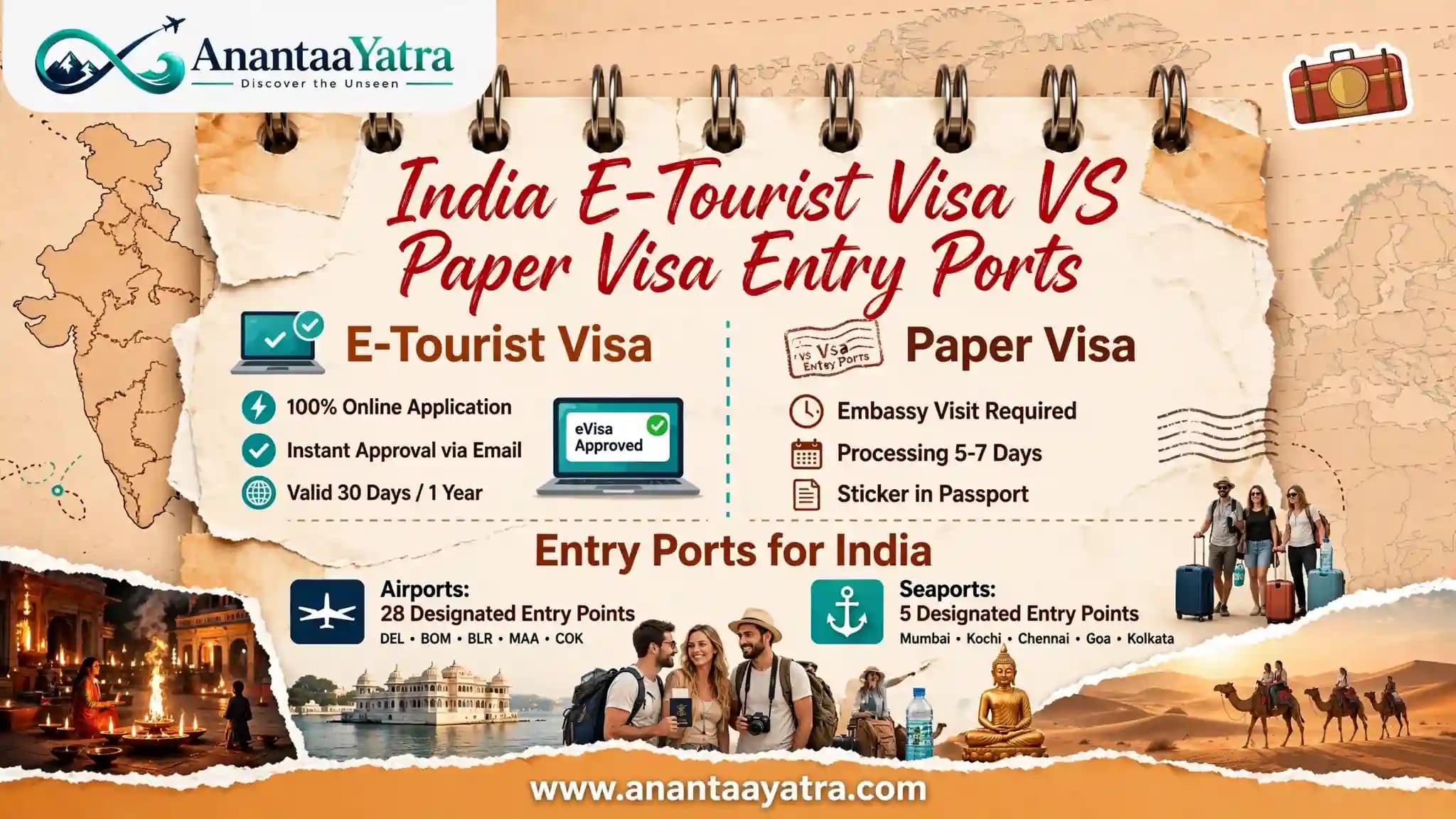
“Compare India’s e-Tourist Visa and regular paper visa, including application steps, fees, authorized entry ports, documents and common rejection mistakes.”
India e-Tourist Visa vs. Paper Visa: Application Guide, Authorized Entry Ports & Common Rejection Traps
Planning a trip to India? Choosing the right visa is only the first step. Your passport details, supporting documents, application timing and intended entry point can all affect whether your journey goes smoothly. This guide explains the difference between India's e-Tourist Visa and regular visa, how the application processes work, and what to check before booking a non-refundable trip.
Visa rules change. This guide is for general travel information, not a guarantee of eligibility or approval. Always confirm your nationality's eligibility, current fee and permitted entry point through the official Indian government portals before applying.
The quick answer
- Choose an e-Tourist Visa if your nationality is eligible, your visit is for an allowed tourism purpose, and your planned entry point accepts e-Visas.
- Consider a regular/paper visa if you are not eligible for the relevant e-Visa, need a visa category not covered by it, or your circumstances require a regular visa.
- Do not travel on a payment receipt. For an e-Visa, check that your ETA says GRANTED and that its details match your passport.
- Check the exact entry port. A port that accepts regular visas may not necessarily accept e-Visa entry.
Cost comparison: e-Tourist Visa vs. regular visa
There is no single price that applies to every visitor. Indian visa fees can vary by nationality, visa duration, visa category and the applicable service or payment charges. Use this table to compare the cost structure before paying.
| Cost factor | e-Tourist Visa | Regular/paper visa |
|---|---|---|
| Government visa fee | Depends on nationality, visa type and duration. | Depends on nationality, visa type, duration and applicable mission fee schedule. |
| Additional charges | Applicable bank/payment charges may be added. | Visa application centre or service charges may apply, depending on location and application route. |
| Payment outcome | The processing fee is generally non-refundable even if the application is refused. | Fees received are generally non-refundable, including in many cases where a visa is not granted. |
| How to confirm the amount | Check the official e-Visa fee page for your passport nationality. | Check the Indian mission or authorised visa application centre responsible for your application. |
Avoid websites promising guaranteed approval or charging unofficial emergency or express e-Visa fees. The Government of India warns applicants to use the official portal and published payment process.
Official fee information: Indian Visa Online fee information.
e-Tourist Visa vs. paper visa: at a glance
| Feature | e-Tourist Visa | Regular/paper visa |
|---|---|---|
| Application route | Online application, document uploads and online payment. | Online form followed by printed application, passport and supporting documents submitted as directed. |
| Approval document | Electronic Travel Authorization (ETA); verify that it is granted. | Visa issued through the relevant Indian mission or authorised process, generally endorsed in the passport. |
| Eligibility | Only eligible nationalities and permitted travel purposes. | Depends on the relevant visa category and the applicant's circumstances. |
| Entry points | Only designated e-Visa entry ports. | Authorised entry points, subject to visa endorsement and applicable immigration rules. |
| Physical submission | Normally no passport submission to a visa centre for the online e-Visa application. | Physical passport and documents are normally required through the relevant mission or centre. |
| Best suited for | Eligible travellers taking an allowed short-term tourism trip. | Travellers who need a regular visa category or are not eligible for the relevant e-Visa. |
| Approval guaranteed? | No. | No. |
The correct choice depends on nationality, travel purpose, intended length of stay and visa conditions. A regular visa is not automatically better, and an e-Visa is not available to every passport holder.
What is an Indian e-Tourist Visa?
An Indian e-Tourist Visa is an electronic visa facility for eligible foreign nationals visiting India for permitted tourism-related purposes. The application is completed online, with a passport image, photograph and any other documents required by the official application system.
If approved, the traveller receives an Electronic Travel Authorization. Check the ETA status on the official portal before departure. A submitted application, payment confirmation or email saying that your form was received is not the same as a granted authorization.
The official e-Visa system offers several visa categories, not just tourism. This article focuses on the e-Tourist Visa; business, medical, student, transit and other categories have their own eligibility and documentation requirements.
Start at the official Indian Visa Online portal and open the e-Visa section.
What is a regular or paper visa?
A regular visa is processed through the relevant Indian mission or designated visa application process. Applicants normally complete the online form, print and sign it, arrange an appointment where required, and submit the passport and supporting documents as instructed.
The process may involve a physical appointment, document checks and additional steps depending on the country where you apply and the visa category. Processing times and document lists can differ between Indian missions, so do not rely solely on a checklist written for another country.
- Open the official regular visa application page.
- Select the correct mission and visa category.
- Complete the form accurately and save the application ID.
- Print and sign the form as instructed.
- Submit the passport, form and supporting documents through the authorised route.
- Follow the application status and collect or receive the passport and visa according to the mission's instructions.
Official application instructions: Regular visa instructions.
Authorized entry ports for India e-Visa holders in 2026
Entry rules are a frequent source of confusion. An e-Visa does not automatically allow entry through every international airport, land border or seaport in India. You must arrive through a port designated for e-Visa entry and comply with the conditions attached to your authorization.
On 10 August 2026, the Ministry of Home Affairs announced an expansion to 88 designated international ports for e-Visa entry: 37 airports, 38 seaports and 13 land ports. As lists can change, check the live official list before finalising a flight, cruise or land route.
Examples of designated e-Visa entry points
Airports include: Delhi, Mumbai, Kolkata, Chennai, Bengaluru, Hyderabad, Bagdogra, Guwahati, Ahmedabad, Amritsar and other designated airports.
Seaports include: Mumbai, Cochin, Chennai, Kolkata, New Mangalore, Port Blair and other ports listed by the government.
Land ports include: Raxaul, Rupaidiha, Jogbani and designated locations such as Agartala, Gede, Ghojadanga, Haridaspur, Jaigaon, Dawki, Moreh and Attari Road, as listed in the government announcement.
This is an illustrative list, not a substitute for the full current official list. The government announcement's table contains a duplicate Darranga entry, so verify the exact border checkpoint and its operational status with the official portal before travel.
The August 2026 announcement is available from the Press Information Bureau, Ministry of Home Affairs release. The e-Visa portal remains the practical place to confirm current designated entry points and application instructions.
Can I enter at one port and leave from another?
The official e-Visa instructions distinguish entry from exit. The designated entry list is restrictive, while departure may be permitted through Indian immigration check posts as specified by the current rules. Confirm your planned route on the official portal rather than assuming that entry and exit permissions are identical.
Does an authorized land port mean every traveller can cross there?
No. The traveller must have the correct visa, meet nationality and travel-purpose requirements, and use a port authorised for that visa type. Border operations, nationality-specific restrictions and the conditions printed on the visa or ETA may also affect the journey.
How to apply for an Indian e-Tourist Visa
- Confirm eligibility. Check that your nationality qualifies and that your purpose of travel is permitted under the e-Tourist Visa category.
- Use the official portal. Avoid lookalike websites and intermediaries that claim to guarantee approval.
- Prepare the passport and photograph. Follow the current upload specifications. Make sure your image is clear and the passport page is fully legible.
- Enter the details carefully. Match your name, passport number, nationality, date of birth and passport expiry exactly to your travel document.
- Complete the required supporting information. The system may request additional information or documents depending on the visa category and applicant.
- Pay through the official payment process. Save the receipt and application reference. Do not assume payment means approval.
- Check the ETA status. Travel only after the authorization is granted and verify that the details are correct.
- Recheck the entry point. Confirm that the airport, seaport or land port you intend to use is currently designated for e-Visa entry.
Official e-Visa instructions: e-Visa process, requirements and FAQs.
Documents to prepare before applying
The exact document list depends on your nationality and visa category. Use this as a preparation checklist, then follow the official application form and mission-specific instructions.
- A valid passport that meets the current validity requirements.
- A clear digital image of the passport's biographical page.
- A recent photograph that meets the published image specifications.
- Accurate proposed travel dates and intended arrival point.
- Previous Indian visa details, where requested by the application.
- Any supporting documents requested for your particular application.
- A payment method accepted by the official application system.
- A copy of the granted ETA or issued visa for your journey.
Do not upload altered, blurred, cropped or misleading documents. Keep your original passport and supporting records available in case immigration officials ask to inspect them.
Common Indian visa rejection traps to avoid
1. Spelling or passport-number mismatch
A small typo in a passport number, name or date of birth can cause problems at check-in or immigration. Compare every field with the passport before submitting the application.
2. Uploading an unclear photograph or passport image
A photo with poor lighting, a distracting background or an unclear passport page may fail the portal's requirements. Use a fresh, sharp image that follows the official dimensions and file instructions.
3. Choosing the wrong visa category
A tourist visa is not a universal permission for every activity. If your main purpose is employment, study, business or medical treatment, review the specific visa categories and conditions rather than assuming the tourist category is sufficient.
4. Applying through an unofficial website
Commercial agents may charge for help, but an intermediary cannot guarantee a government decision. Start from the official Indian Visa Online portal and confirm the URL before entering passport or payment information.
5. Assuming a fast processing estimate is a promise
Processing time can vary. Do not book a tight connection or non-refundable itinerary on the assumption that your application will be approved by a particular date. Apply well ahead of travel and wait for the final status.
6. Travelling before the ETA is granted
A receipt, application ID or pending status is not a travel authorization. Check the official status and confirm that the ETA says GRANTED before departure.
7. Using an entry port that does not accept e-Visas
This is particularly important for overland travellers and cruise passengers. Verify the precise port or border checkpoint, not just the city or country you are travelling from.
8. Overlooking previous visa or travel-history questions
Answer every question truthfully. If a form requests previous visa details and you cannot locate them, follow the portal's current instructions rather than guessing or entering information you know is incorrect.
9. Treating the fee as refundable
Visa processing fees are generally non-refundable even if an application is refused. Confirm the category, nationality-specific fee and details before paying.
10. Confusing an arrival card with a visa
India's e-Arrival card is an arrival-information requirement; it is not a visa and does not replace a required visa or granted e-Visa. Check the official portal for the latest instructions on whether and when you must complete it.
Final pre-departure checklist
- My nationality is eligible for the visa category I selected.
- My visa or ETA has been granted, not merely submitted or paid for.
- The name and passport details on the authorization are correct.
- My passport meets the current validity requirements.
- My intended entry port appears on the official list for my visa.
- I have checked the permitted number of entries and validity dates.
- I have saved an offline copy of the authorization and application records.
- I have checked the latest official immigration and arrival requirements.
Frequently asked questions
Is an Indian e-Tourist Visa the same as a regular paper visa?
No. An e-Tourist Visa is applied for online and requires a granted ETA before travel. A regular visa uses an online form followed by the physical submission process specified by the relevant Indian mission or visa application centre.
Can I enter India through any airport with an e-Visa?
No. e-Visa holders must enter through a designated airport, seaport or land immigration check post approved for e-Visa entry. Check the current official list before booking.
How much does an Indian e-Tourist Visa cost?
The fee depends on nationality, visa category and applicable payment charges. Check the official Indian Visa Online portal for the fee applicable to your passport.
Does paying for an e-Visa mean it has been approved?
No. Payment or submission does not equal approval. Confirm that the official status is GRANTED and that the authorization details match your passport before travelling.
Can I get an Indian visa on arrival?
India has limited visa-on-arrival arrangements for specific nationalities and designated airports. Most travellers who use the e-Visa facility must apply online and receive a granted ETA before travelling. Check the official visa-on-arrival rules for your nationality; do not assume that you qualify.
Can I use an e-Visa to enter India by land?
Entry is permitted only through designated land immigration check posts authorised for e-Visa holders. Confirm that the exact checkpoint is listed for e-Visa entry and that your nationality and visa conditions allow your planned journey.
What should I do if my e-Visa is rejected?
Review the official application instructions and any communication provided through the application system. Do not assume a new application will be approved automatically. Check the applicable rules and fees before deciding whether to submit another application or use a regular visa route.
Official sources and further reading
Visa conditions and entry-point lists may change. Use government sources for the final decision, especially when planning a land crossing, cruise arrival or itinerary with non-refundable bookings.
Explore more with Anantaayatra
Planning a wider India trip? Explore our travel resources for destination inspiration and trip planning.
Internal-link publishing note: the homepage and the previously supplied Bishnupur article URL are known references. The other routes above have not been independently confirmed as live in this lookup. Replace any unavailable URL with the exact matching page from your website before publication; do not leave broken internal links online.